“The monster”
The Reincarnationist Papers“The monster” is Evan Michaels’s name for the fire he deliberately kindles, but the expression reaches beyond the flames. It gathers together the pleasure and danger of setting a blaze, the return of a childhood fire remembered through Bobby Lynn Murray, and Evan’s belief that fire can bring the past back into the present. The monster is something he summons and tries to direct; it is also a force that exceeds his plan.
A name for fire
Evan’s lighter hovers over a narrow trail of vodka on a warehouse floor. He concentrates, breathes smoke over his shaking hand, and moves the flame close enough for it to leap from the lighter and run along the liquid. In this deliberate preparation, the fire is not simply an accident or an impersonal hazard. Evan watches its beginning closely, and the act of summoning is, by his account, the most exciting part. He says, “I love to summon the monster.” The language makes ignition feel like an arrival: a small flame becomes an active presence with an appetite and a course of its own.
The name holds a contradiction from its first appearance. Evan associates the monster with the truth carried back from the past, but also with the image of a child consumed by fire. He describes it as a bringer of deliverance even as he recognizes its capacity to destroy. These meanings are not neatly separated: the same blaze that recalls a terrible event is also the thing Evan has deliberately called into being. His language gives fire an almost independent character without removing his responsibility for starting it.
A remembered pattern
Evan’s account of the flames’ movement is also an account of what he has learned by experience. At first, the fire follows the thin vodka trail, appearing blue within a pale yellow outline. It reaches a larger puddle, then slowly spreads beyond the liquid onto floorboards treated with methanol and wax. As it catches those materials, its color changes toward orange. The blaze climbs a post and reaches the rafters. Evan notes that it can begin its work once it is on its feet and moving, a judgment he says he learned the first time he summoned it.
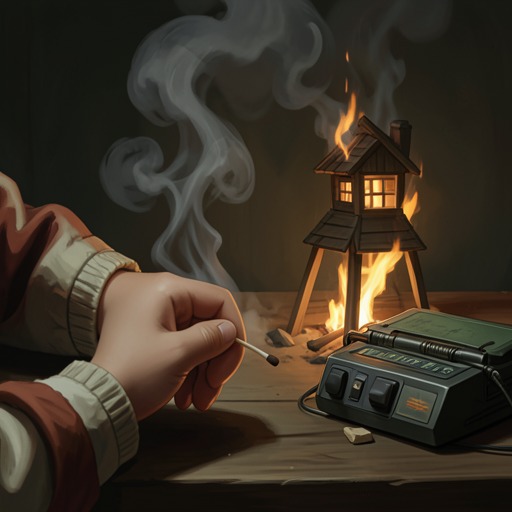
That earlier pattern is tied to Bobby Lynn Murray, whose memory intrudes on Evan during his last week in Minnesota. The remembered event takes place in Macon, Georgia, in 1976, when Bobby is six. A painstakingly built tower of Tinker Toys stands in his bedroom; after his mother Judith puts him to bed, he gets up to inspect it in the dim light and tries to identify the colored rods needed to continue building. While checking a yellow rod with a match, he accidentally transfers the flame to the tower. It travels up the painted supports, catches the curtains, and spreads to the surrounding walls and ceiling. Bobby’s memory ends with him under the bed, looking out after the flash and seeing his mother aflame in the doorway.
The parallel between that remembered fire and Evan’s later one gives the expression its force. The monster’s recurring movements do not make the two events identical: Bobby’s blaze begins accidentally in a child’s bedroom, while Evan prepares a path for fire in an empty warehouse. But Evan explicitly recognizes the new fire as being for Bobby, and calls himself the ghost in the room. In this way the image binds a present act of arson to a past that has returned through memory, rather than treating the warehouse fire as an isolated episode.
Control and reversal
Evan’s language suggests that he expects to manage the fire. In the warehouse, he leaves an unprimed strip as a route to the stairs and watches the flames advance across the floor. He distinguishes the tall flames below from the rolling fire along the ceiling, and waits for the blaze to reach a stage at which he can set it free. The description grants the fire a will of its own, but also shows Evan making calculations about its spread and timing. His control depends on a narrow margin: the route he has preserved is meant to keep him out of its path.
That margin nearly disappears when the flames travel silently across the ceiling above his safety strip. Evan realizes that the route is at risk of being cut off and retreats toward the stairs. The fire he has called and studied has moved beyond the plan he made for it. He reaches the stairs by crawling and scrambling down before escaping through the warehouse door; outside, he leaves the blaze burning behind him in Los Angeles. The episode turns the expression back on Evan: the monster is not only the imagined agent he watches, but also the danger he must flee.
Memory, agency, and consequence
The expression’s central tension lies in its double use. Evan speaks of the fire as something that carries truth across time and as a force that can consume, while the narrative shows him arranging the conditions for ignition. Personifying the blaze gives its spread the shape of a return—something that comes, grows, and searches—yet the warehouse scene keeps the human decisions that summoned it in view. The monster’s apparent independence does not erase the distinction between Bobby’s accidental ignition and Evan’s deliberate one.
The name also links repetition with consequence. Evan has seen the fire’s pattern before, and the memory of Bobby’s bedroom gives that pattern a history; nevertheless, knowing its behavior does not make the present blaze fully controllable. When the ceiling fire crosses the route Evan reserved for his escape, his plan becomes a near trap. “The monster” therefore names neither fire alone nor a simple metaphor for memory. It is the point where a remembered catastrophe, Evan’s deliberate act, and the danger of repeating a pattern meet.